
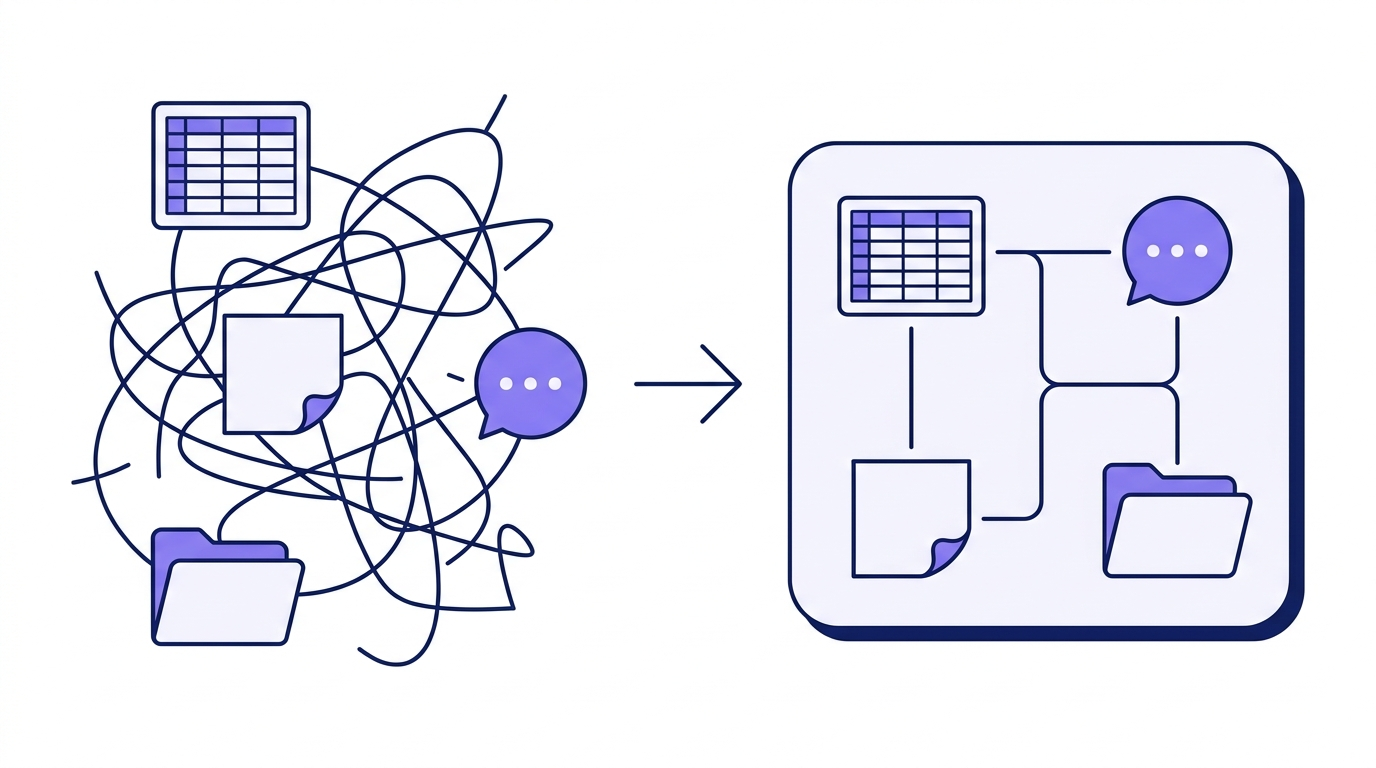
If you’re running your side hustle on a stack of automation scripts and ready-made templates, there’s a specific moment when that setup stops being enough. It usually has nothing to do with revenue or how many hours you’re putting in. The clearest sign your side hustle needs business infrastructure — not just another script — is when automation stops saving you time and starts creating new busywork instead: you’re the one reconciling numbers across five different tools, or patching a broken workflow by hand every other week.
This matters because creators and solo entrepreneurs tend to solve every new problem the same way: find a template, write a script, add one more tool. It works for a while. Then the sheer number of small moving parts becomes the actual bottleneck, and no new script fixes that, because the problem isn’t a missing task anymore — it’s a missing foundation underneath all of them.

Three signs your automation has outgrown itself
These three signs tend to show up together when this shift happens:
- A patchwork that only works because you personally glue it together. Copying data from one place to another, double-checking that two systems agree, remembering which spreadsheet is the “real” one this week.
- No single source of truth. Client records live in one place, project status in another, invoices somewhere else entirely — and none of them talk to each other.
- You’ve become the single point of failure. If you’re the only person who understands how your own automation works, you can’t hand off a task, take a real break, or bring someone else in without walking them through your entire private system first.
None of these are automation problems. They’re infrastructure problems, and it helps to be clear about the difference.
Automation vs. business infrastructure
Automation speeds up a single repeated task: send this reminder, generate this file, post this update. Infrastructure is the underlying system that holds the business together, so those automated tasks actually mean something — one place where client information lives, one place invoices get generated and tracked, a setup that still works when a second person joins.
| Signal | Automation only | Real infrastructure |
|---|---|---|
| Client & project records | Scattered across tools and spreadsheets | One shared system anyone on the team can open |
| Invoicing | Manual, tracked in email threads | Centralized and tracked in one place |
| If you disappear for 2 weeks | Things quietly break | Operations keep running |
| Bringing someone else in | Requires a long walkthrough | Documented, delegation-ready |
A side hustle running on scripts and templates typically has automation without infrastructure. Each script does its one job well, but there’s no shared structure connecting them. A small business that’s made the jump usually has both: automated tasks that plug into a system built to hold the whole operation, not just a series of individual chores.
What real business infrastructure actually covers
Real infrastructure usually covers a handful of things automation alone doesn’t touch:
- Client and project management that anyone on the team could open and understand, not just you
- Invoicing and payment tracking that lives in one place instead of scattered across emails and screenshots
- Documented operational workflows a new hire or contractor could actually follow
- A setup that’s genuinely delegation-ready, so someone else could step in without a two-hour walkthrough first
This is the point where ready-to-use digital infrastructure providers become relevant, rather than another one-off script. Business infrastructure providers like Blueprintly Tech build complete management systems and business kits specifically for entrepreneurs setting up real operational structure — a reasonable example of what that next step tends to look like in practice: pre-packaged systems built to hold a growing business together, instead of a growing pile of individually automated tasks.
A simple way to check where you stand
Ask what happens if you disappeared for two weeks. If the honest answer is “everything breaks or slows down because it all depends on me remembering how my own scripts work,” that’s your answer. If the business would keep running reasonably well because the systems underneath it don’t depend entirely on your memory, you’ve already got real infrastructure — whether or not you’ve called it that.
None of this means your automation was wasted effort. Scripts and templates are usually how people first get organized at all, and they’re often the right starting point. The shift just means recognizing when the thing you actually need next is a system, not one more script.
How to actually start this week
Moving from scripts to infrastructure doesn’t have to mean ripping everything out and starting over. A more realistic first pass looks like this:

- Write down every place client or project information currently lives. Spreadsheets, chat threads, sticky notes, a folder on your desktop — just list them. Most people are surprised to find it’s five or six places, not one.
- Pick one thing to consolidate first. Client records are usually the highest-value starting point, since they touch invoicing, project status, and communication all at once.
- Write down the steps someone else would need to follow to do your job for a week. If you can’t write it down clearly, that’s the actual gap — not a missing tool, a missing process.
- Only then look at pre-built systems. Trying to buy infrastructure before you know what you’re consolidating usually means paying for features you don’t use yet, and missing ones you actually need.
This order matters more than which specific tool or provider you end up choosing. A documented process moved into a mediocre system still beats an undocumented mess automated with expensive software.
Key takeaways
- Outgrowing your automation shows up as more manual glue-work, not less.
- The clearest test: could your business run for two weeks without you?
- Infrastructure isn’t a bigger script — it’s the shared system every automated task plugs into.
- Moving from scripts to infrastructure isn’t a sign your earlier setup failed; it’s usually the next natural step.
FAQ
Is this just about buying more software?
No. Infrastructure is as much about structure and documentation as it is about tools — a well-organized spreadsheet system can outperform an expensive tool used without any shared structure behind it.
How do I know if I need infrastructure or just a better script?
If the problem is one repeated task taking too long, that’s still automation territory. If the problem is that no one else — including future you — could pick up where you left off, that’s an infrastructure gap.
Does this only apply to side hustles that want to go full-time?
No. Plenty of side hustles stay side hustles by choice, but still benefit from infrastructure once a few clients or collaborators are involved, simply because coordination gets harder faster than revenue does.
Sources
- Chase Bank — “Tips and Steps To Turn a Side Hustle Into a Business,” chase.com
- InCorp — “When a Gig Becomes a Real Business,” incorp.com
Conclusion
Automation gets a side hustle off the ground. Infrastructure is what lets it keep running without you holding every piece together by hand. Neither one replaces the other — they just solve different problems, at different stages.
Still automating one task at a time? See Kermit V2’s automation templates to speed up the repetitive work while you figure out your next step.
Leave a Reply