
Less than 20% of U.S. businesses with four or fewer employees are currently using AI, according to data collected by the Census Bureau from December 2025 to May 2026. This presents a gap, not in the decision to automate repetitive tasks with AI agents, but in the ability to identify which repetitive tasks are most suited for AI, and which are only suited for a basic automation tool.
The term “AI agent” is used very often and is used very loosely. A lot of what is advertised as AI agents is actually a chat interface that is coupled with a rule-based automation. The differentiation is important as both solve unique problems, and applying the wrong solution to a problem will likely cost more time than it saves.

What actually counts as an AI agent
A traditional automation is when a specific action (Y) will always follow a specific occurrence (X). This kind of automation is effective and expedient. However, it is important to note that the automation is incapable of going beyond what has been anticipated. An AI agent is when a system is able to evaluate a wide variety of inputs, decide the rationale behind the specific situation, and identify the most pertinent solutions, rather than trigger a fixed endpoint.
In practice, a rule that automatically forwards every email with the subject line “invoice” to a bookkeeping folder is an automation. A system that reviews an incoming email, determines if it is in fact an invoice, pulls the vendor and amount, and drafts a categorized entry is more aligned with what an AI agent is.
Three kinds of repetitive tasks solo entrepreneurs hand off first
Not every repetitive task is a good candidate for the same tool. Three patterns show up constantly:
- Tasks that follow a predictable format. These tasks hit the same trigger and repeat the same steps. This is automation territory and using an AI agent for this is unnecessary.
- Tasks that require reading and judgment before acting. Using an AI agent to draft a reply to an email is an example. These tasks have different inputs every time.
- Repetitive tasks that are judgment-free and could benefit from being done quickly and imperfectly. First-draft social media captions and meeting notes fit here too, and can also benefit from the use of an AI agent. A sub-par first draft is better than no draft at all, since a human still reviews it before it goes out.
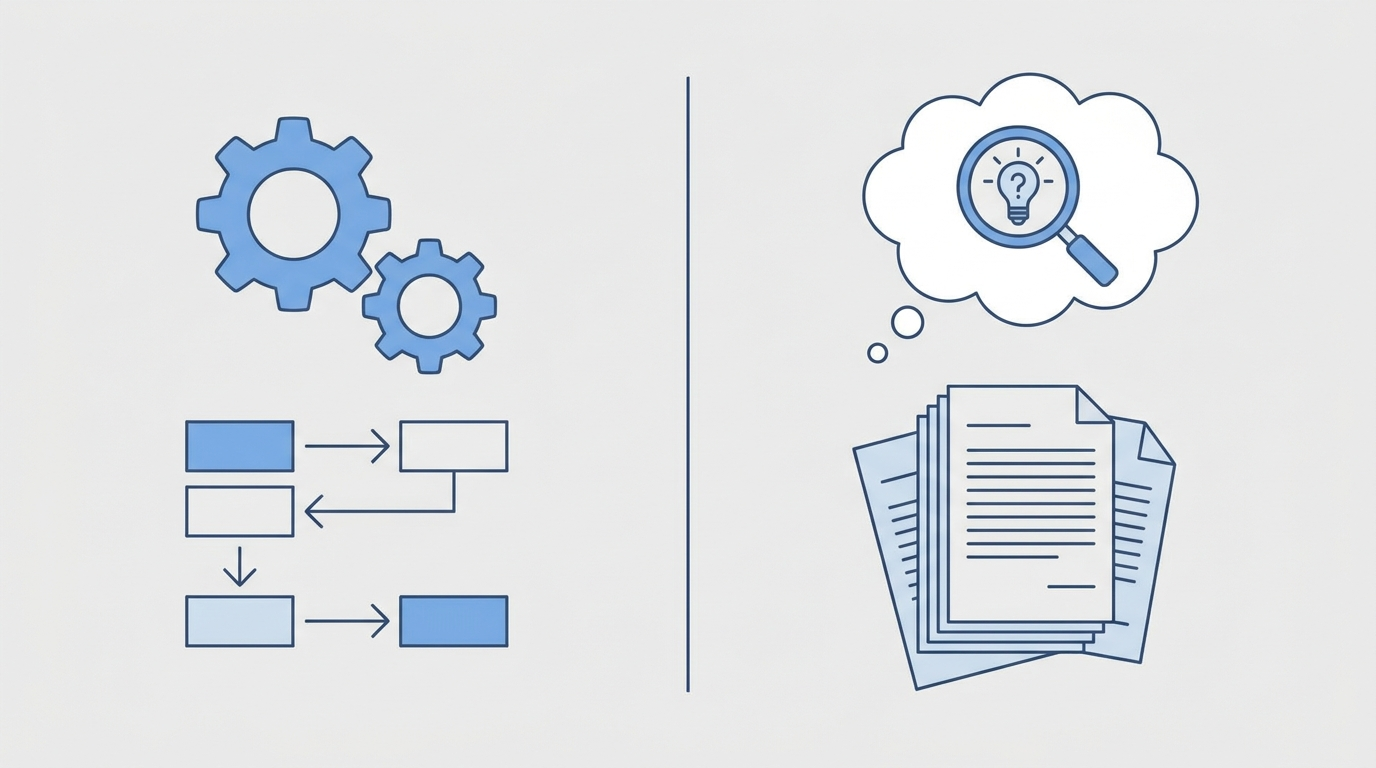
How to automate repetitive tasks with AI agents vs. traditional automation
| Question | Traditional automation | AI agent |
|---|---|---|
| Does the input look the same every time? | Yes — this is the right fit | Not necessary, adds cost without benefit |
| Does the task require reading and interpreting free-form text? | Struggles or breaks on anything unexpected | This is the actual use case |
| How predictable does the output need to be? | Fully predictable, same result every run | Variable — needs a human review step |
| Setup effort | Low — one-time trigger and action | Higher — needs instructions, examples, and review |
Most solo businesses need both, running side by side. Traditional automation quietly handles the fixed, predictable tasks in the background. An AI agent takes on the smaller number of tasks that involve reading, judgment, or a first draft — and a person still checks the output before it goes anywhere important.
A simple framework: rule-based, judgment-based, or hybrid
Before you put a program to work on a task, ask yourself if the task requires dealing with the specific context of a task, or if it can be completed by following a series of steps.
- Rule-based: the boundaries of acceptable work don’t change with the context — sending a reminder, moving a file, updating a status. Use automation for this type of task.
- Judgment-based: requires reading a message to decide how to respond, or deciding which lead to follow up with first. An AI agent makes sense here.
- Hybrid: the AI agent handles the judgment part of the task, and automation handles the rest.
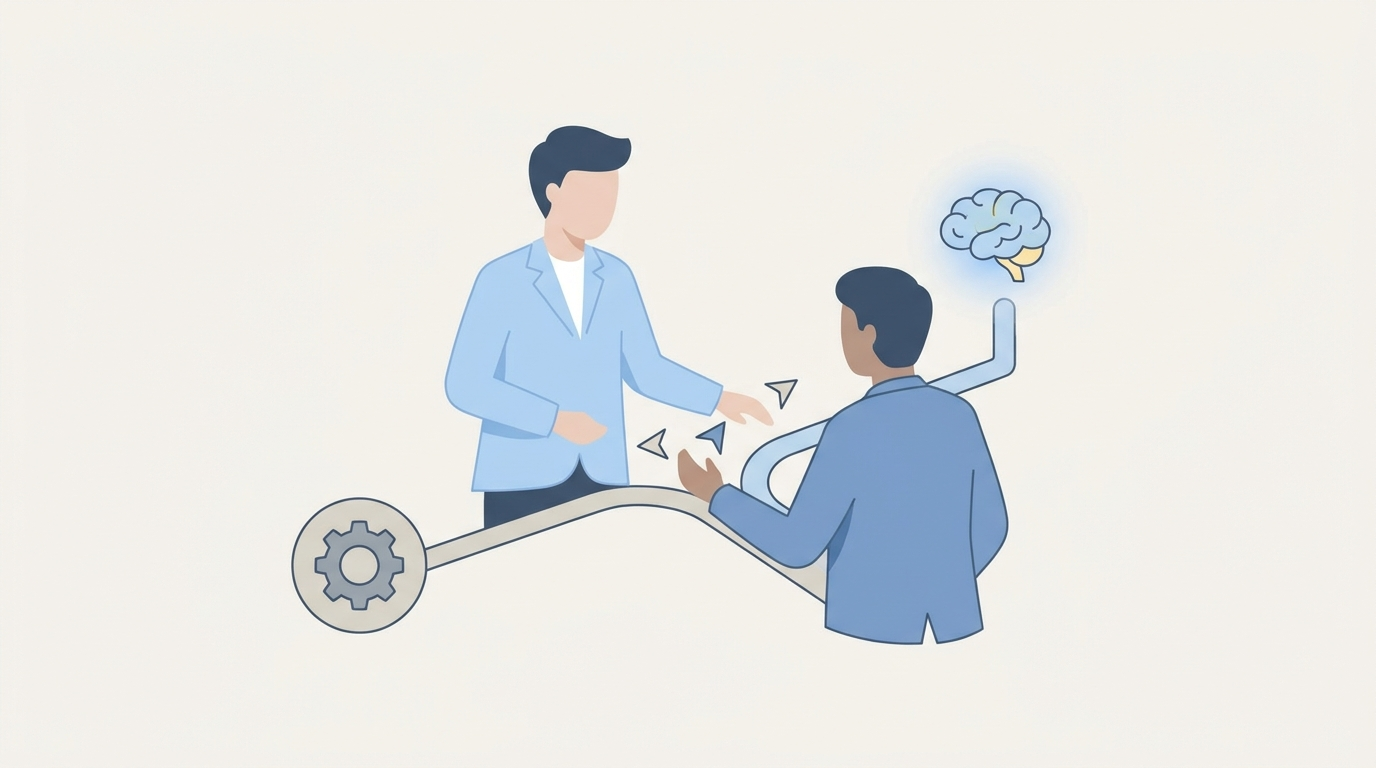
Where AI agents still get it wrong
AI agents are limited. These agents can misread certain requests or draft a reply that’s too informal and miss the mark. This shouldn’t be a reason to avoid using AI agents. This should simply motivate a human review step for anything that goes out to a client or affects money, at least until you’ve seen enough of the agent’s output on your own tasks to trust it. Treating early AI agent output as a draft, not a final answer, is what separates the solo entrepreneurs who get real value from this from the ones who get burned once and give up.
How to start this week
- Write out all of your repetitive tasks from the past week. Take a minute and list them without filtering yet.
- Classify each task as rule-based, judgment-based, or hybrid. Most will probably fall into the rule-based category, with only a few judgment-based tasks.
- Automate a rule-based task first. It’s the fastest way to get started.
- Choose one judgment-based task to test an AI agent on. Not several — just one, so you can properly evaluate it before adding more.
- Review its output for a couple of weeks before trusting it further. This step is essential to avoid automation mistakes, and it’s the one people skip.
For solo entrepreneurs who’d rather start from a working structure than build the rule-based layer from scratch, Kermit V2’s automation templates cover the fixed, predictable side of this — the sequences and workflows an AI agent’s judgment-based output can plug into once it’s ready.
Key takeaways
- Less than 20% of the smallest U.S. firms currently use AI, per Census Bureau data — most solo entrepreneurs are still deciding where to start.
- Traditional automation and AI agents solve different problems: fixed-format tasks versus tasks that require reading and judgment.
- Start with one judgment-based task, not five, and review its output for two weeks before trusting it unsupervised.
- Most mature workflows end up hybrid: an AI agent handles the judgment call, then hands off to plain automation for the predictable part.
FAQ
Do I need an AI agent if I already use Zapier or Make?
Not necessarily. Zapier-style tools are traditional automation — excellent for rule-based tasks. An AI agent is worth adding specifically for the judgment-based tasks those tools can’t handle, not as a replacement for them.
What’s the biggest mistake solo entrepreneurs make with AI agents?
Handing over too many tasks at once without a review step. Starting with one task and watching its output closely for a couple of weeks catches mistakes before they reach a client.
Is this only relevant to tech-heavy businesses?
No. The framework — rule-based, judgment-based, or hybrid — applies to any repetitive task involving text, scheduling, or client communication, regardless of industry.
Sources
- U.S. Census Bureau — “Large Firms With at Least 20 Employees Biggest AI Users,” Business Trends and Outlook Survey, census.gov
- PwC — “PwC’s AI Agent Survey,” pwc.com
Conclusion
It’s not about whether to use AI agents or automation. It’s about knowing which repetitive task is best suited to each option. Plain automation is sufficient for rule-based tasks. For judgment-based tasks, it’s better to use AI agents. For each task, you will need a human to validate the results and slowly start to trust the AI agent.
Ready to handle the rule-based side of your workflow? See Kermit V2’s automation templates and free up your attention for the tasks that actually need judgment.
Leave a Reply